A New Project, One Page at a Time
A first-session project plan gives a group a shared result, a first deliverable, and a reporting owner without pretending every later question is settled.
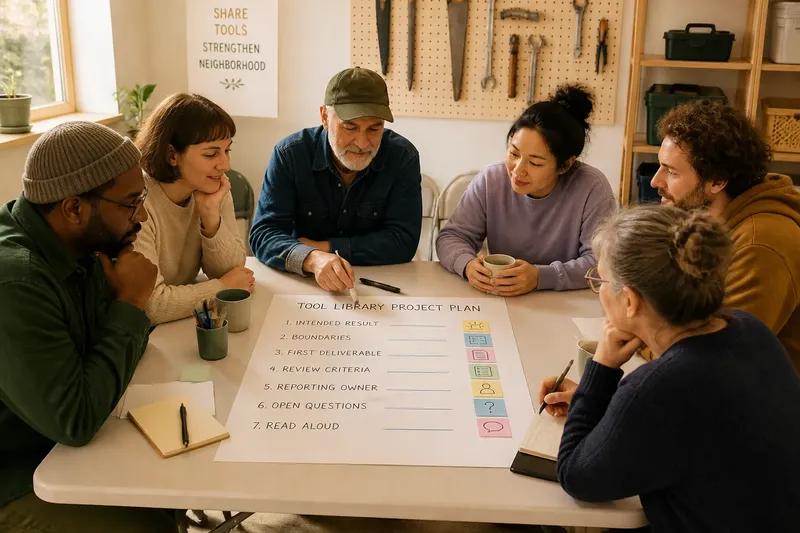
The first meeting for a neighborhood tool library begins with a folding table, a borrowed marker, and six people who have each brought a different idea of what “ready” means. A one-page project plan gives them somewhere useful to put those ideas without turning the afternoon into a referendum on every future detail.
The aim is modest: write the intended result, name the first deliverable, and agree who will report back. The page is a starting point, not a miniature contract. Work through these items in order, stopping when the group has enough clarity to begin.
1. Name the intended result
Write one sentence describing what should be true when the project has achieved its purpose. Keep the sentence about the result, not the activity. “Set up a tool library” names work; “Neighbors can borrow commonly needed tools through a clear, workable process” describes the change that work is meant to produce.
Ask whether someone outside the group could tell, in ordinary terms, what success would look like. If the answer depends on a long explanation of meetings held, documents written, or effort spent, revise the sentence. Those may be useful activities, but they are not the result itself.
Say you and a few neighbors want to reduce the awkward business of borrowing a drill from whoever happens to be home. You might write: “Residents can find, borrow, and return shared tools using a process they understand.” That sentence leaves room for later choices about storage and scheduling while giving the group a common destination.
2. Mark the boundaries
A new project can absorb every nearby improvement. The tool library group may want to organize repair workshops, create a donation campaign, and publish maintenance tips before it has a shelf for a hammer. Record the intended result, then note a small number of things the first effort does not include.
Boundaries protect attention, not anyone’s favorite idea. A useful note might say, “This first phase covers borrowing and returns; workshops can be considered later.” Avoid writing a detailed exclusion list. If the page needs several paragraphs of defense, the group is probably trying to solve a disagreement that deserves a separate conversation.
Keep any boundary provisional when the group lacks enough information to make it permanent. A clear “not now” is more useful than a vague “maybe somehow” and less dramatic than pretending no one had the idea.
3. Choose the first deliverable
The first deliverable is a tangible piece of work the group can review. It should connect directly to the intended result and be small enough to complete before the group needs to invent a larger plan. For the tool library, that could be a draft borrowing sheet listing the information a borrower and volunteer need to exchange.
Distinguish the deliverable from the activity. “Discuss what information to collect” is a meeting task; “a draft borrowing sheet for review” is something the group can look at, question, and revise. Tangible work makes the next conversation more specific.
Choose one deliverable, not an ambitious bundle. If the first item is a complete catalog, storage system, lending policy, and public launch, it is not a first deliverable; it is a project wearing a smaller hat.
4. Define what review means
A draft is easier to produce when its reader knows what to assess. Agree on a few practical questions for the first review. For a borrowing sheet, the group might ask whether a volunteer can identify the tool, record who borrowed it, and understand how a return is noted.
These questions are not a final standard for the whole project. They help the group decide whether the deliverable is usable enough to discuss and what information remains missing. A review that asks only “Do we like it?” invites a collection of preferences without much help in choosing among them.
Keep the review criteria close to the intended result. If an item cannot plausibly help the group judge whether the first deliverable supports that result, leave it for later. The page has limited space, a quality that occasionally improves human conversation.
5. Assign a reporting owner
Name one person who will bring back the next update. This is not a declaration that the person owns the project or must do every piece of work. It gives the group a clear point of contact for reporting what was completed, what remains uncertain, and what the group needs to decide next.
Make the reporting commitment concrete. Agree on the next meeting or communication channel, and specify what the person will report: the draft deliverable, its open questions, and any help needed. If other people will contribute, write their names beside those contributions rather than implying that the reporting owner has silently acquired every task.
For the invented tool library group, Mira might agree to bring a draft borrowing sheet to the next gathering and identify questions that volunteers cannot answer yet. Another neighbor could supply a list of tools already offered. Mira reports the state of the work; the list’s contributor remains responsible for that piece.
6. Capture open questions
Put unresolved matters in a short “open questions” area. The tool library group may not yet know where tools will be stored or how to handle a missing item. Recording those questions acknowledges them without forcing the first session to settle matters that do not block the first deliverable.
Separate an open question from an immediate obstacle. If the borrowing sheet cannot be drafted without knowing which tools exist, that information may be needed now. If storage arrangements do not affect the sheet’s first draft, they can wait. This distinction helps the group avoid treating every unknown as an emergency.
Do not fill the page with every possibility anyone can imagine. Keep the questions that could change the next piece of work or require a later group choice. The rest can remain unrecorded until they become relevant.
7. Read the page aloud
Before ending the session, read the page aloud and invite corrections. Listen for words different people interpret differently, especially terms such as “ready,” “shared,” or “complete.” If a sentence sounds clear only because the writer remembers the discussion, revise it until the page can stand on its own.
Confirm that the intended result, first deliverable, reporting owner, and next report are all present. A useful page is short enough to revisit and specific enough to guide the next action. It need not settle the budget, every role, the final schedule, or the shape of the project’s later stages.
One thing is not worth the effort at this meeting: polishing the page until it looks official. A plain document or sheet of paper is sufficient. Formatting cannot resolve a fuzzy result, and a decorative title does not volunteer to report back.
What belongs on the first page?
How long should the first project plan be?
Keep it to one page if that is enough to show the result, first deliverable, reporting owner, next update, and a few open questions. If the group needs more room, add only the detail needed to begin the next piece of work.
Should the group decide every role at the first meeting?
No. Name who will report back and clarify any contribution needed for the first deliverable. Roles for later work can wait until the group knows what that work involves.
What if people disagree about the intended result?
Write down the competing versions in plain language and identify what differs between them. The group can revise the result together before assigning the first deliverable; a polished page built around incompatible aims is still a polished problem.
When should the page be revised?
Revise it when the group learns something that changes the intended result, the first deliverable, or who needs to report back. Do not rewrite it merely because the project has moved from a table to a shared document.
Keep the page useful
A new project plan earns its place by helping people take the next shared action, not by predicting the whole journey. The first page should make the intended result visible, give the group one concrete deliverable to review, and say who will report back. When those details change, update the page; until then, let the group work.
For a new project, one page at a time is not a rule against planning further ahead. It is a way to make the next conversation answerable: what are we trying to achieve, what can we put in front of one another first, and who will bring back the next account of the work?